Identify the firearms and their legal owner, document your wishes through appropriate estate planning, and confirm the recipient’s eligibility and the applicable transfer rules. A lifetime gift, an inheritance, and a trust-held firearm can follow different paths. Federal, state, and local requirements matter. 2A Ledger helps organize the collection and supporting records; legal documents and lawful transfers still need separate attention.
01 · Understand the transfer
“It’s staying in the family” is only the beginning.
Start by identifying how ownership will change. The federal inheritance exception does not apply to every family transfer.
During your lifetime
Giving a firearm as a gift
A gift to a family member in another state generally needs to go through a federally licensed firearms dealer (FFL). Being related does not itself create an interstate gift exception. Same-state transfers can also have state requirements.
After your death
Passing a firearm by inheritance
Federal law provides an exception to the usual interstate nonlicensee restriction for a lawful bequest or intestate succession—inheritance under state law when there is no will. The recipient must be legally permitted to acquire or possess the firearm in their home state.
A will identifies wishes. Eligibility still matters.
An heir’s name in a will does not override possession restrictions. Ask an estate attorney about the governing documents and an alternate beneficiary or lawful sale if the intended recipient cannot accept the item. Minor beneficiaries, recipients in another state, and restricted firearm types deserve specific review. See ATF’s prohibited-person guidance.
Check the actual jurisdictions. Confirm requirements where the collection is located and where the recipient lives, plus any transport rules. Start with ATF’s state-law directory, then consult current state statutes, the state firearms authority, and qualified counsel. A directory is a starting point, not a complete legal determination.
02 · Special items, lasting responsibilities
Federal nonenforcement does not change state law.
The NFA has not been repealed. ATF’s October 9, 2026 guidance announces nonenforcement of certain NFA requirements for suppressors, short-barreled rifles and shotguns, and “any other weapons.” That is an enforcement policy—not a change to state or local law or permanent protection for a future transfer. Policy may change under a later administration or court ruling. Machine guns and destructive devices remain subject to full NFA requirements. Read the current ATF guidance and its limits.
Preserve approvals. Verify the lawful path before possession changes.
The registered-firearm estate framework in 27 CFR § 479.90a permits a state-authorized executor to possess a decedent’s registered NFA firearm during probate. It calls for an application by probate’s close and a Form 5 for a beneficiary, with the executor’s authority, death certificate, and will if any. The NFA Handbook describes approval before distribution. Have counsel or ATF clarify how current policy affects that process; separately confirm state requirements.
Keep existing approval and registration documents. Identify whether an individual, trust, or other entity owns each item. Trust-owned items need review of the trust and successor authority. Do not assume a missing document means an item is unregistered—or that nonenforcement makes possession or transfer lawful everywhere.
Movement rules also need review. ATF’s October 9 open letter discusses continuing interstate transportation requirements for short-barreled rifles and shotguns. Confirm the rules in force when the transfer or transport occurs.
03 · Give them a place to start
Firearm inheritance checklist: prepare your family’s records.
Work through these eight steps while you can still explain the collection yourself. The goal is a clear set of records your family and authorized representative can actually use.
Free printable worksheet
Take the checklist with you.
Eight preparation steps, plus a cover sheet for documents, contacts, backups, and questions for your attorney.
Identify each item.Record manufacturer, model, caliber or gauge, serial number where present, and distinctive markings. Keep suppressors and other separate items individually identifiable.
Take useful photos.Include the whole item and readable identifying marks. Match every photo to the correct record.
Gather supporting paperwork.Locate receipts, transfer records, approvals, appraisals, and ownership documents. Retain originals and record where they are kept.
Identify the legal owner.Flag personally owned, trust-owned, jointly claimed, borrowed, or already sold items for review. Do not assume possession means ownership.
Record the history and your wishes.Explain family significance and intended recipients in notes. Have an attorney put enforceable instructions in the appropriate estate documents.
Plan for value and alternatives.Keep purchase cost separate from a dated value estimate or appraisal. Discuss a lawful sale if family members do not want the collection.
Prepare access and an independent backup.Tell the appropriate trusted person where the records and documents are. Plan secure access to the computer, inventory password, and backup.
Print, review, and keep it current.Give your representative a dated starting inventory. Update after purchases, sales, moves, or changes to your estate plan.
What you should have when you finish
A dated inventory, an index showing where the original documents are kept, and contact information for your estate attorney and a knowledgeable firearms professional. Keep access instructions secure and separate from copies you share broadly.
Review the packet with the person you expect to help. Make sure they can identify a record, find its supporting documents, and understand whom to contact. Include a plan for illness or incapacity as well as death; have counsel document the appropriate authority for each situation.
How 2A Ledger helps your family understand the collection
Your family may recognize a photograph before they recognize a model name. Keeping the item’s details and supporting records together gives them a practical starting point.
See the actual output
A record your family can read.
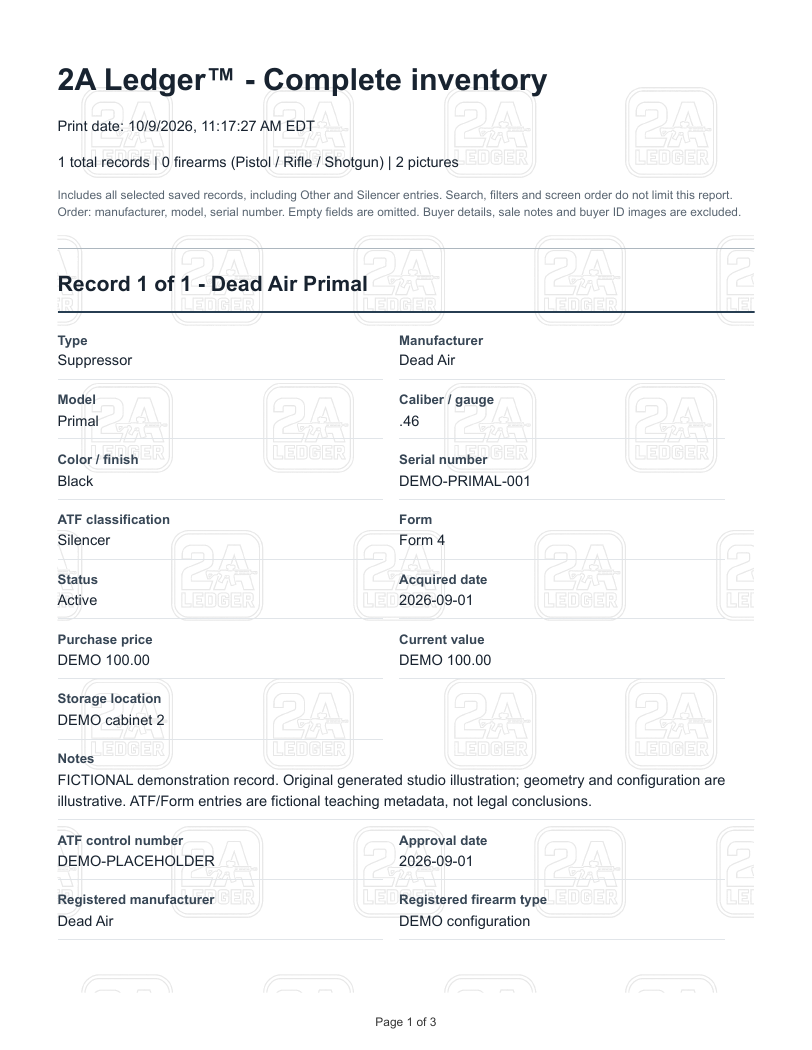
This is the first page of the published three-page 2A Ledger print sample. It contains fictional demonstration information and shows the record details and watermarks.
Use the sample to see the format, then prepare and verify a copy of your own records in the app.
Published RC.51 sample · 3 pages · 4 MB · Opens in a new tab. Example ATF entries are fictional and do not establish legal status.
What your family needs
What you can prepare in 2A Ledger
“Which one is this?”
An individual record with identifying details and photographs.
“Where is its paperwork?”
Supporting PDFs associated with the item, with a separate plan for original documents.
“Why did it matter to him?”
Notes preserving the item’s history, family connection, and context.
“What is still in the collection?”
Current inventory and Sold history to review alongside the physical collection.
“Can we take this to the attorney?”
A printed inventory or selected records for discussion with your representative, attorney, or dealer.
“What if the computer fails?”
An independent backup, verified in a separate test copy, with a secure access plan.
Prepare a copy for your attorney.
Use Export HTML backup, when available for your inventory, to create a readable copy of the records. Save the file to a USB drive you can hand to your attorney, or send it using the attorney’s preferred email or secure-upload method. This gives your attorney a useful reference when discussing the collection, intended beneficiaries, and estate documents.
Open the exported file before sharing it and check that the records and attachments you intend to provide are present. Keep the original receipts, approvals, and estate documents; your attorney will tell you which originals or additional evidence are needed.
HTML exports are readable outside desktop password protection. The app blocks unprotected HTML export when sensitive sale history is present. Preserve that history in a protected backup and follow the customer guide; do not remove records simply to enable an export. A protected .flvault backup serves a different purpose from a readable copy for your attorney.
Keep the records on your computer and decide who receives copies. Review the released features and customer guide for available printing, export, and protection options.
Plan access now. The inventory password is separate from the activation key, and support cannot recover a forgotten inventory password. A printed inventory offers a readable starting point. Readable exports expose the information they contain; protect them appropriately. An inventory file is not a will, trust, appraisal, ownership certificate, or completed transfer.
A family handoff, made concrete
Three records. A clearer place to start.
Here’s how you can prepare a small collection for your family. Give each item a clear record, note where the original paperwork is kept, and take unresolved questions to your attorney.
Fictional planning example · Item details, identifiers, document locations, and wishes below are illustrative.
Record 01 · Rifle
Ruger 10/22
DEMO-FAMILY-001 · .22 LR
History to preserve
“The rifle we used for our first family range days.”
Paperwork to locate
Receipt and dated photographs in the family records folder.
Question for counsel
How should your wishes be reflected in your estate plan?
Record 02 · Shotgun
Mossberg 500
DEMO-FAMILY-002 · 12 gauge
History to preserve
“Passed down from my father; keep the handwritten story with it.”
Paperwork to locate
Earlier family records and any evidence of how it was acquired.
Question for counsel
What ownership questions need resolving before distribution?
Record 03 · Suppressor
Dead Air Primal
DEMO-FAMILY-003 · .46
History to preserve
Identify the item separately from any firearm used with it.
Paperwork to locate
Existing approval and registration documents, plus any trust documents.
Question for counsel
Who owns it, and which current estate, transfer, and state rules apply?
What you hand to your attorney
A dated reference copy. Print the relevant records or use the app’s HTML export where permitted; open and review the copy first.
A document index. Identify where originals are kept and which papers still need to be located.
A short question list. Review ownership, intended recipients, authority during incapacity or probate, and lawful transfer requirements.
The result is a useful starting packet for legal review. Passwords, safe combinations, activation keys, and sensitive buyer information stay out of broadly shared copies.
The downloadable example is a readable planning handout created for this guide. It is not an app backup or a file to import into 2A Ledger.
05 · Keep the history with the collection
Help your family understand what makes each one matter.
A firearm may connect your family to a person, a place, or a memory. Those details are easy to lose when they have never been written down.
You may know who first owned it, why you bought it, or which family member has always admired it. Add that context while it is still yours to tell. A few thoughtful notes alongside the photographs can help the next generation understand what they are receiving.
Where it came from. Record previous family owners, when it joined the collection, and how it came to you.
The memories attached to it. Preserve a meaningful hunt, a day at the range, a gift, or another moment your family would want to remember.
What you want them to know. Explain its significance, identify related photographs or keepsakes, and record any history that still needs to be confirmed.
Keep intended gifts and family wishes consistent with your estate documents. Personal notes help explain your intentions; your attorney can help put those intentions into effect.
06 · Direct answers
Firearm inheritance questions families ask
Can I leave a firearm to someone in another state?
A lawful bequest or intestate succession can fall within the federal interstate inheritance exception. The heir must be eligible, and the firearm and transfer must comply with applicable law. See § 478.30. A lifetime gift uses a different analysis.
Does a will automatically make the transfer legal?
No. A will can direct estate distribution, but it cannot override firearm possession restrictions or required transfer procedures. Confirm the legal owner, the recipient’s eligibility, and the requirements for the particular item.
Does ATF nonenforcement mean my family can ignore NFA paperwork?
No. An enforcement policy is not repeal, does not override state or local law, and can change. Preserve existing documents and obtain guidance on the lawful estate-transfer and registration process before possession changes. Check ATF’s current policy and the applicable state requirements.
Does a receipt or printed inventory prove legal ownership?
These can help identify items and document acquisition, but neither settles every ownership or legal question. Preserve original documents and resolve disputes or trust ownership through the appropriate professional.
What if my family does not want the firearms?
Discuss alternate beneficiaries and lawful sale options in advance. Give your representative accurate records and contacts for a reputable dealer or qualified appraiser. Purchase price alone is not current market value.
Can my family recover a protected inventory without the password?
Support cannot recover a forgotten inventory password. Arrange secure access in advance and verify an independent backup. Read the password protection guide; avoid relying on a single inaccessible computer.
Can I give my attorney a copy on USB or by email?
Yes. Where the app permits an HTML backup, save that file to a USB drive for your attorney, or send it using the attorney’s preferred email or secure-upload method. Open and review the exported file first. HTML backups are readable outside the app’s password protection, so share only with the intended recipient. Your attorney can use the records for review and tell you which original documents are also needed. See the export and backup guidance.
What should we do first if we have already inherited a collection?
Keep the collection secured and obtain qualified help if you are unfamiliar with safe handling. Locate the inventory, estate documents, and any existing approvals. Contact the authorized estate representative and attorney before distributing items or moving them across state lines. A family member’s access to the records does not by itself establish authority to possess or transfer the firearms.
Does 2A Ledger create a will or complete a firearm transfer?
No. It organizes the records you maintain. Estate planning, eligibility decisions, dealer procedures, and government filings remain separate.
07 · Check the originals
Official sources and further reading
Consult current guidance at the time of a transfer. Older summaries may not reflect recent policy changes.
Prepared by 2A Ledger / YourEMR LLC, the maker of the software. Legal references link to primary federal sources; software instructions are based on the published customer guide. This is an educational overview, not an attorney-reviewed opinion on your circumstances.
Sources checked: . Check the rules that apply when a transfer or transport actually occurs. Federal enforcement policy does not replace state or local law.
Found an outdated reference? Send a source correction. Please leave serial numbers, passwords, and personal records out of the message.
General U.S. educational information, not legal advice or a determination that a particular transfer is lawful. Rules and enforcement policies can change. Consult a qualified attorney and the appropriate authority for your circumstances. 2A Ledger is independent recordkeeping software and is not affiliated with ATF.
Start with one item
Pass along the collection. And the knowledge to understand it.
Add the photo. Record the details. Keep the supporting paperwork together. Give your family a clearer place to start.