Traditional sporting bullets
Flat-nose, round-nose, and soft-point designs remain important in these cartridge families. For tubular magazines, use ammunition specifically approved by the manufacturer.
 2A Ledger™Your Electronic Munitions Record
THE CARTRIDGE LIBRARY · LARGE-BORE CENTERFIRE
Alexander Arms' large-bore cartridge uses its own case and cartridge dimensions. Its name identifies a particular commercial cartridge, rather than every .50-caliber sporting load.
2A Ledger reference desk · Sources checked October 18, 2026
Know the exact name
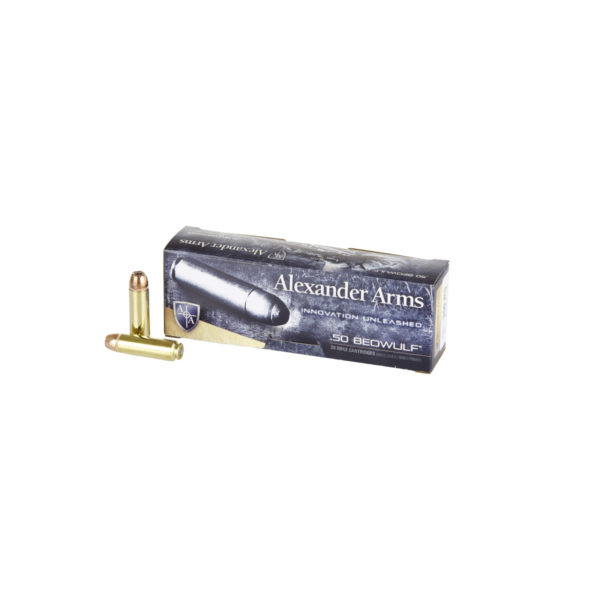
.50 Beowulf is identified by its complete cartridge designation. The resource-table alternative is Beowulf. A caliber number, bullet diameter, or family resemblance on its own does not identify ammunition compatibility.
Do not substitute .50 Action Express or other .50-caliber ammunition based on bullet diameter.
Manufacturer reference; no SAAMI maximum is claimed.
Dimensions: open the named cartridge reference ↗. The displayed number is reference bullet ø, rather than an assertion that every manufactured projectile or barrel has this exact diameter.
Origins & evolution
Bill Alexander introduced the .50 Beowulf in 2001 as a large-bore cartridge for the AR-15. Its strongly rebated rim accommodated a broad case body within that compact rifle system. The name came from the Old English epic, a theme continued by the later 6.5 Grendel.
Alexander Arms subsequently emphasized sporting use in its own account of the cartridge’s role. The Beowulf belongs to the early commercial wave of big-bore AR cartridges, pursuing a different purpose from the small, high-velocity ammunition usually associated with the platform.
Historical sources: Alexander Arms: Beowulf purpose and development context ↗ · American Rifleman: original Beowulf evaluation and introduction history ↗
Construction changes the story
Flat-nose, round-nose, and soft-point designs remain important in these cartridge families. For tubular magazines, use ammunition specifically approved by the manufacturer.
Flexible tips, bonded bullets, monolithic expanding bullets, and solids have different functions. A similar exterior shape or shared diameter does not establish equivalent behavior.
Some older cartridge families span firearms with very different operating limits. Keep any product restrictions with the ammunition record and use only loads authorized for that firearm.
In the cited .50 Beowulf examples, bullet weights are 300 grains. These are the weights actually present in this source selection, not a claim that every possible loading is listed.
Bullet construction background: Hornady: anatomy of a bullet ↗. Exact product descriptions and velocities are cited in the factory table.
1,793 fps
FTX
| Maker / product | Bullet mass | Published construction | Muzzle velocity | Test barrel | Source |
|---|---|---|---|---|---|
| Alexander Arms300 FTX test | 300 gr 19.44 g | FTX | 1,793 fps 547 m/s | 16 in | Alexander Arms ↗ |
Explore the published data
The sources checked for this guide do not provide a comparable barrel-length series. A single factory muzzle-velocity specification does not establish a velocity curve. The factory records and any missing test conditions are identified below.
An estimate needs an anchor and a defensible method. No curve has been invented from bullet diameter or from another cartridge’s name.
Changing bullet weight also often changes bullet design and propellant choice. Two curves are comparisons of the listed products, not a controlled experiment proving that bullet weight alone caused the difference. Catalog downrange points are projections under the maker’s conditions; barrel-study points are recorded observations in the study firearm.
Direct answers
Alexander Arms' large-bore cartridge uses its own case and cartridge dimensions. Its name identifies a particular commercial cartridge, rather than every .50-caliber sporting load.
The named identification reference gives 0.5000 inches (12.700 mm), reference bullet ø. This reference value is different from a casual caliber nickname.
Do not substitute .50 Action Express or other .50-caliber ammunition based on bullet diameter.
This guide has no supported multi-point graph in the sources reviewed. Its factory specifications and source links are shown in the load section.
Energy is calculated from mass and velocity. It does not establish accuracy, expansion, penetration, pattern density, recoil, or suitability for a particular firearm. Use the exact product documentation and firearm manual.
Trace the facts
Compiled by 2A Ledger from the linked standards, manufacturer publications, and identified test records. Checked October 18, 2026. Historical tests and older catalogs retain their original dates; a listing here does not establish current availability.
Diameter figures preserve the cited drawing convention. Inch–millimeter conversion uses exactly 25.4 mm per inch. Factory specifications describe the maker’s test setup; your firearm, ammunition lot, temperature, and measuring method can produce different results. This is an educational factory-ammunition reference, not a reloading manual.